QIMC Just Hit Its Highest Hydrogen Reading Yet and It’s Still OPEN at Depth
Hydrogen Results from Hole DDH-26-02 at West Advocate, Confirming Multiple Zones Across Depth Including Stronger Deeper Interval
Mar 19, 2026, 07:25 GMT
Montreal, Quebec–(Newsfile Corp. – March 19, 2026) – Québec Innovative Materials Corp. (CSE: QIMC) (OTCQB: QIMCF) (FSE: 7FJ) (“QIMC” or the “Company”) reports headspace gas results from DDH-26-02, the second borehole in its 2026 natural hydrogen exploration program at the West Advocate project, located within the Cobequid-Chedabucto Fault Zone (“CCFZ”), Nova Scotia.
DDH-26-02 recorded a peak hydrogen concentration of 8,249 ppmV at 434 m depth, representing the highest single reading observed in the current drilling program and approximately 2.75 times the peak value recorded in the first hole, DDH-26-01. Hydrogen concentrations remained elevated at 500 m, where drilling was terminated due to seasonal ground conditions, indicating the system remains open at depth, and a surface soil-gas anomaly identified in prior work lies northwest of the bottom of the hole, beyond the depth reached by drilling to date. All hydrogen concentrations measured from borehole water samples are subject to dilution effects as previously disclosed in the Company’s March 10 press release, including work by Prof. Marc Richer-Laflèche.
Why This Result Matters
The two-hole dataset provides the Company with its first subsurface view of hydrogen distribution at West Advocate. Key observations include:
- Hydrogen concentrations increase with depth in both holes completed to date, toward the basement contact targeted under the Company’s R2G2™ model, as interpreted from current data
- DDH-26-02 returned higher hydrogen values and a greater number of elevated readings compared to DDH-26-01
- The distribution of hydrogen concentrations is consistent with structural controls on fluid movement within the fault corridor
- Results are consistent with the Company’s pre-drill R2G2 targeting model, which anticipated increasing hydrogen concentrations toward the northwest
Program Highlights
- Peak hydrogen concentration of 8,249 ppmV at 434 m depth
- Approximately 2.75× higher peak value than DDH-26-01
- 24 of 164 samples (15%) exceeded 1,000 ppmV H₂; 10 samples (6%) exceeded 2,000 ppmV
- Hydrogen concentrations increase with depth in both holes completed to date
- Two hydrogen-bearing intervals identified:
- Zone I: 125–160 m (thrust fault damage zone)
- Zone II: 425–500 m (fractured pebbly sandstone and conglomerate)
- A 6.5 m mudstone interval below Zone II is interpreted as a potential permeability barrier
- Multi-gas analysis indicates reducing conditions consistent with hydrogen-related processes
- Elevated magnetic susceptibility locally observed and interpreted as potentially associated with redox processes
- Hydrogen concentrations remained elevated at the end of the hole, indicating the system remains open at depth
- Independent scientific oversight by Prof. Marc Richer-Laflèche, INRS (Institut National de la Recherche Scientifique), Québec
The results from Hole DDH-26-02 indicate that elevated hydrogen concentrations were encountered across multiple intervals, including a deeper zone between approximately 425 m and 500 m interpreted as a permeable interval associated with fluid movement. Hydrogen readings remained elevated at the end of drilling, indicating the system remains open at depth. The increasing frequency and intensity of hydrogen values at depth, together with geological and geophysical observations, support the interpretation of a structurally controlled system that may extend beyond the current limits of drilling. Drilling to date has not fully tested the depth extent of the system due to seasonal ground conditions.
Hole DDH-26-02 demonstrates that hydrogen is not confined to a single interval, but occurs across multiple zones, with stronger and more consistent readings observed at depth. The persistence of elevated hydrogen at the end of drilling indicates that the system has not yet been fully defined. Together, these results suggest the Company is progressively refining its understanding of a broader hydrogen-bearing system, with additional potential remaining to be tested at depth and along structural trends.
CEO Commentary
“The results from DDH-26-02 reinforce the consistency we are beginning to observe across the system. Both holes completed to date show hydrogen concentrations increasing with depth, and DDH-26-02 returned stronger and more frequent readings than the first hole. These results support the continuity of hydrogen occurrences and help guide the next phase of the drilling as we continue to evaluate the system.”
— John Karagiannidis, President & Chief Executive Officer, QIMC
Geological Information from DDH-26-02
DDH-26-02 encountered two structurally distinct zones where hydrogen concentrations were elevated — one at shallow depth associated with a fault damage zone, and one deeper zone hosted in fractured coarse-grained rocks. Understanding how these zones relate to each other and to the broader fault architecture is central to targeting the remaining boreholes.
The detailed and rigorous core description provides a solid foundation for further interpretation of the dynamics of natural hydrogen circulation in Greville Fm rocks and more precisely in the vicinity of boreholes DDH-26-01 and DDH-26-02. QIMC’s headspace gas analysis reveals two distinct intervals with elevated H₂ concentrations: Zone I (125–160 m) and Zone II (425–500 m). Zone I corresponds to a thrust fault damage zone characterized by highly deformed, broken core and gauge-rich intervals, affecting variably oxidized sedimentary rocks (Fig. 1a). This interval exhibits high apparent porosity and permeability (visually evident though not measured in a laboratory), bounded below by a silicified siltstone band and above by an arkosic sandstone-pebble unit interlayered with thick siltstone and mudstone horizons (Fig. 1d). The combination of silicified siltstone and fine-grained sedimentary facies appears to partially focus hydrogen migration within the more permeable thrust zone.
Below Zone I, headspace hydrogen concentrations remain low until the appearance of a sandstone with minor mudstone package intruded by many thin granitic dykes, marking the end of a relatively low-permeability interval. At greater depth, the stratigraphy becomes dominated by pebbly sandstones with minor mudstone interbeds (Fig. 1d). This coarser, more brittle succession hosts several H₂ peaks exceeding 1,000 ppmV. The highest concentrations in DDH-26-02 occur within Zone II, pebbly sandstone (8,249 ppmV), and more precisely at the end of a zone of fractured rocks as shown by the RQD data. These coarse sedimentary units directly overlie a 6.5 m mudstone bed, which is interpreted as a permeability barrier, restricting lateral flow and concentrating hydrogen within the underlying more permeable fractured conglomeratic sandstones.
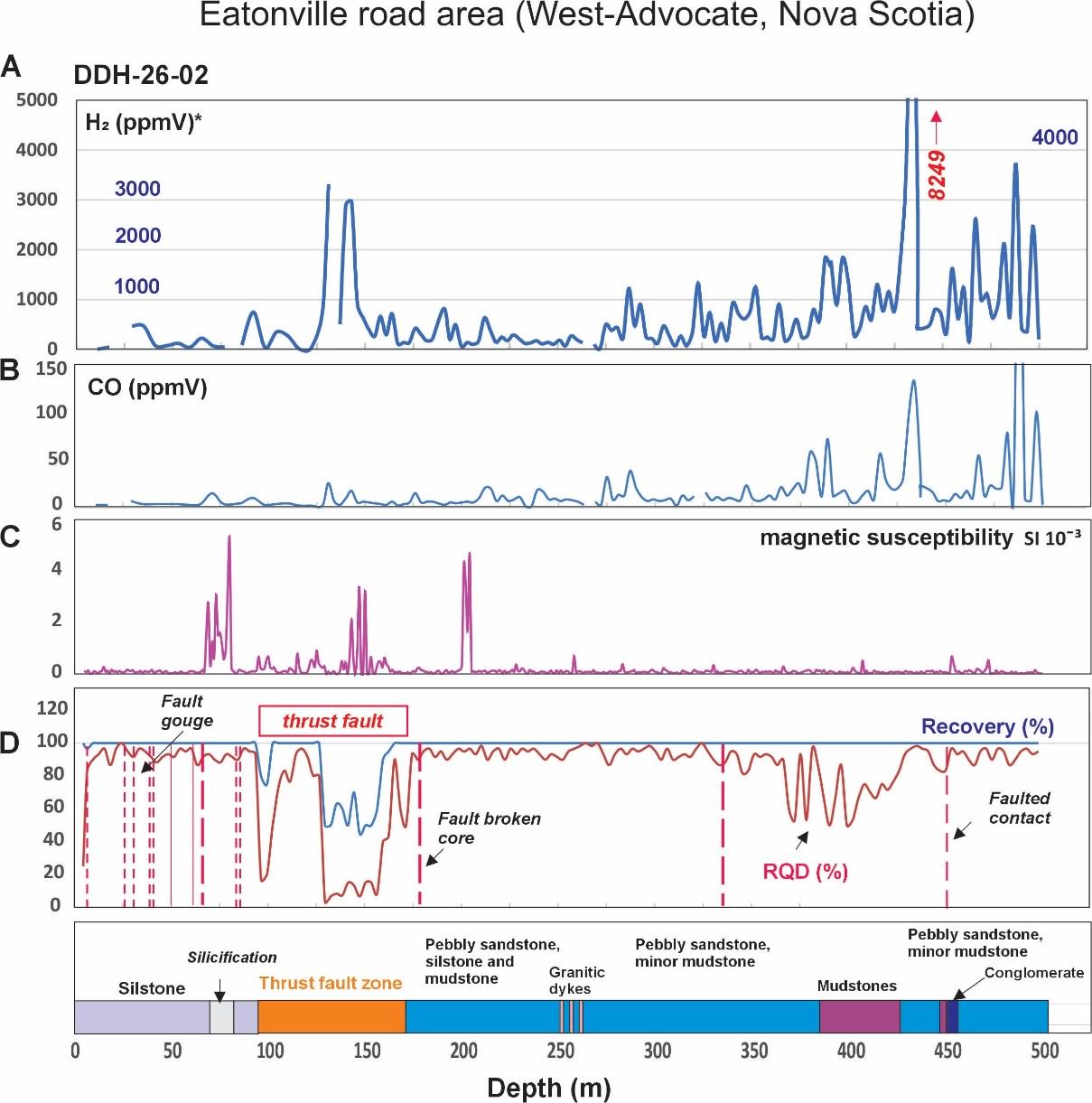
Figure 1. Summary diagram showing the variability of H₂ (A) and CO (B) concentrations (ppmV), magnetic susceptibility (SI × 10⁻³) (C), and lithological and structural observations (D) from hole DDH-26-02.
Rock Fracturing
The degree and style of rock fracturing directly controls where hydrogen can migrate and accumulate. In simple terms, harder, more brittle rocks tend to crack and create open pathways for hydrogen movement, while softer, finer-grained rocks tend to seal or redirect that flow. The fracture pattern observed in DDH-26-02 is consistent with this model and helps explain why the two hydrogen-bearing zones occur where they do.
In DDH-26-02, the alternation of siltstone, sandstone, minor mudstone, and the transition into pebbly sandstone and conglomerate toward the base creates a mechanically heterogeneous stratigraphic package that strongly influences both transpressional deformation and the present-day migration of natural H₂ through the deformed Early Carboniferous rocks. Competent units such as sandstone and conglomerate tend to fracture, dilate, and concentrate brittle strain, producing high-permeability pathways for hydrogen-bearing fluids and gas. In contrast, finer-grained siltstones and mudstones deform more ductilely and can act as local barriers that redirect and focus fluid and gas flow into adjacent brittle layers.
Zone I, which largely corresponds to the thrust fault damage zone, shows both high core loss and intense fracturing, reflected in very low RQD values (Fig. 1d). Zone II is characterized by intermediate RQD values, indicating fractured rock but lacking the fault-related core loss intervals that define Zone I. Drilling reached approximately 500 m before pausing due to seasonal ground conditions, while elevated hydrogen concentrations continued to be recorded, indicating the system remains open at depth. The drill was subsequently mobilized to the next planned location within the program. As a result, the overall fracture architecture of Zone II at depth remains uncertain.
The high H₂ concentrations recorded in the final samples of the borehole are consistent with an open, permeable system at greater depth — an interpretation supported by the maximum soil-gas anomaly observed at surface northwest of the DDH-26-02 section end.
Hydrogen Headspace Gas Results from DDH-26-02
The headspace gas results quantify the hydrogen detected in borehole water samples collected at regular intervals throughout the drill program. The data show not only the peak concentration achieved, but also how frequently high readings occurred across the full length of the hole — both of which are relevant indicators of the extent and intensity of hydrogen circulation.
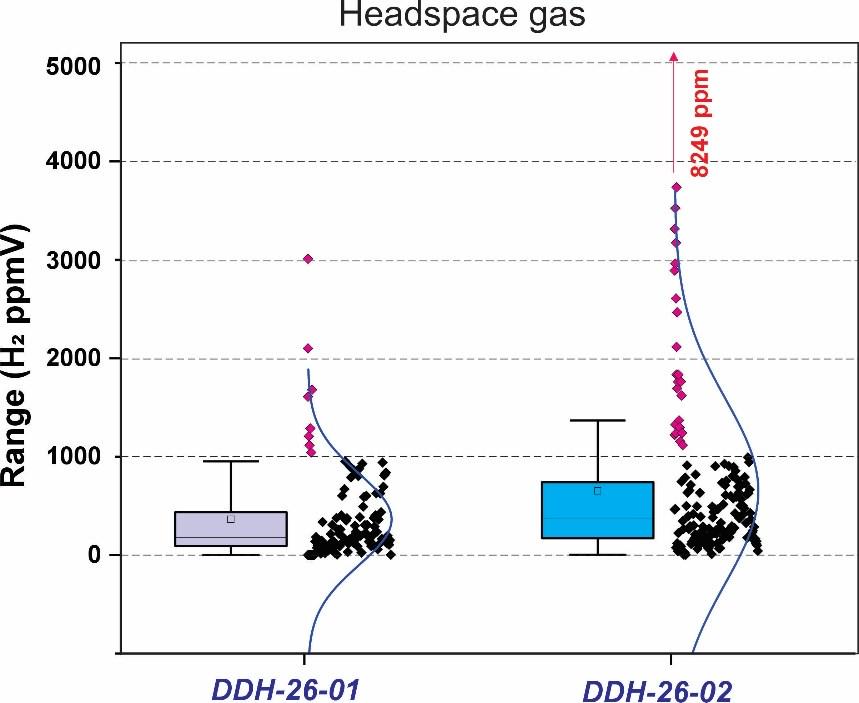
A total of 164 water samples were collected and analyzed for headspace gas concentrations. Of these, 24 samples (15%) contained more than 1,000 ppmV of hydrogen. As shown in Figure 2, 14 samples (9%) fall within the 1,000–2,000 ppmV range, while 10 samples (6%) exceed 2,000 ppmV. The highest concentration, 8,249 ppmV, was recorded at a depth of 434 m. A statistical summary of the hydrogen data is presented in Figure 2.
The magnitude and spatial distribution of these values along DDH-26-02 indicate active hydrogen circulation, largely controlled by the permeability of the faulted and fractured sedimentary rocks. Compared with DDH-26-01, DDH-26-02 shows a greater number of anomalies above the 1,000, 2,000, and 3,000 ppmV thresholds. The maximum concentration in DDH-26-02 (8,249 ppmV) exceeds the highest value in DDH-26-01 by a factor of 2.75, consistent with the pre-drill prediction of increasing hydrogen concentrations toward the interpreted igneous basement, represented locally by a magnetic and gravimetric high.
Figure 2. Distribution of H₂ concentrations (ppmV) in the headspace fraction of water samples taken from boreholes DDH-26-01 and DDH-26-02.
Geochemical Observations — Redox Conditions
Beyond measuring hydrogen concentrations, the full suite of gases detected in DDH-26-02 provides independent evidence about the chemical environment at depth. The pattern of gases observed is consistent with strongly reducing conditions — the geochemical signature expected where hydrogen is being generated through water-rock interaction. This multi-gas fingerprint adds a layer of scientific corroboration to the hydrogen readings themselves.
Lithological contrast enhances fault-parallel channelization and promotes redox reactions where migrating H₂ encounters iron-rich minerals within the sedimentary sequence. These interactions may account for the magnetite-forming alteration and associated magnetic susceptibility anomalies observed in the Greville Formation siltstones (Fig. 1c), interpreted as the product of hydrogen-driven reduction of Fe(III) phases in clays, hematite, oxyhydroxides, and minor iron carbonates.
The headspace gas data further support the importance of redox processes. The presence of CO in trace amounts is notable, as CO is not typically abundant in siliciclastic-dominated sedimentary basins (Fig. 1b), and its occurrence indicates strongly reducing conditions in the hydrogen-bearing fluids. This interpretation is reinforced by the detection of trace H₂S and consistently low CO₂ concentrations.
Principal component analysis of the full headspace gas suite (Fig. 3) shows that H₂, CO, and H₂S co-vary strongly along PC1, indicating control by a common reducing geochemical domain consistent with water-rock interaction processes such as Fe²⁺ oxidation and serpentinization-style reactions. CO₂ projects in the opposite direction along PC1, indicating a strong negative correlation with the reduced gas group. O₂ is nearly orthogonal to both clusters, reflecting variable atmospheric contamination from surface water circulation rather than in-situ geochemical processes.
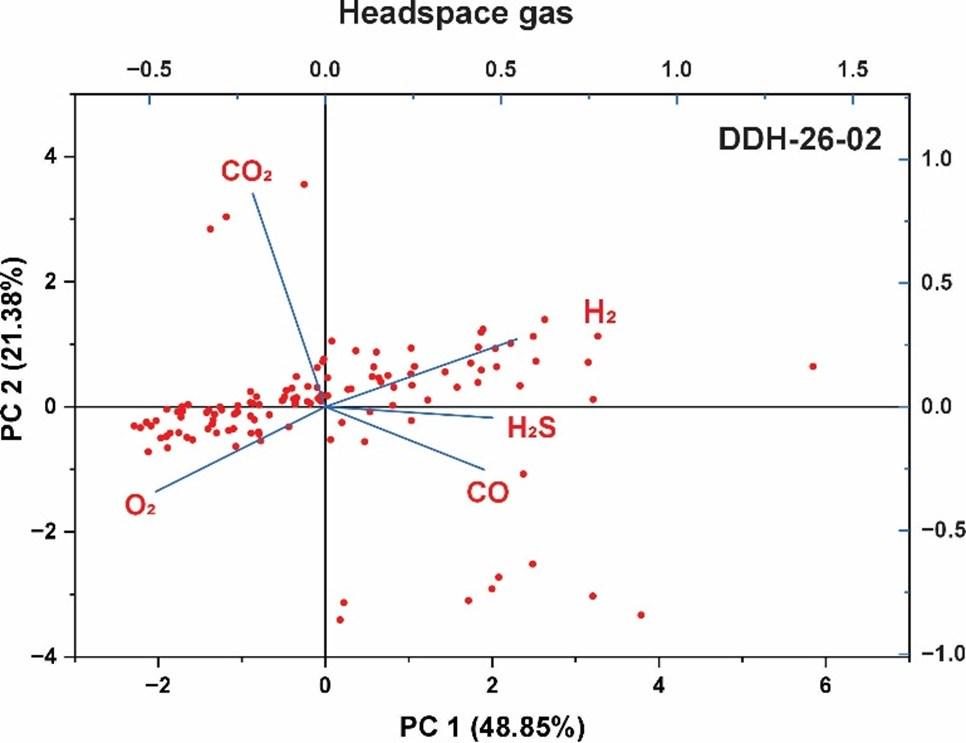
Figure 3. Principal component analysis of headspace analyses from water samples collected in borehole DDH-26-02 in the Eatonville Rd area of West-Advocate.
Methodology: Headspace Gas Analysis
The following describes how hydrogen was measured in the field. The method was designed for continuous, around-the-clock sampling in a remote location without access to a fixed laboratory. A correction factor was applied to account for a systematic and well-characterized underestimation inherent to the bag sampling technique; all reported concentrations reflect this adjustment.
The QIMC field team conducted headspace gas analyses following a protocol recommended by INRS, designed for remote drilling campaigns without access to a fixed laboratory. A mobile, autonomous laboratory was used to collect water samples from wellheads continuously on a 24-hour basis. Sampling was performed at the end of each 3 m drilling interval, with drilling operations and the water supply pump temporarily shut down for each sample.
Water samples were collected in two-litre leak-proof bottles filled with 1,300 mL of borehole water. Once equilibrated to 22°C, samples were vigorously shaken three times and the extracted headspace gas transferred into multi-layer foil sampling bags. Gas concentrations were measured using a Landtec GA5000 analyzer (CH₄, CO₂, CO, O₂, H₂S, H₂). Samples exceeding the GA5000’s 1,000 ppmV H₂ upper limit were re-analyzed using an Eagle 2 instrument capable of measuring higher concentrations. Both instruments were factory calibrated, with bump tests performed twice daily.
Systematic comparison of bag measurements against certified calibration gas standards identified a consistent underestimation inherent to the bag sampling method. A correction factor of 1.324 — derived from two independent calibration points at 500 ppmV and 1,000 ppmV, which produced virtually identical bias values (1.322 and 1.326 respectively) — was applied uniformly to all reported hydrogen values. All reported concentrations reflect this correction.
Exploration Program — Status
The 2026 West-Advocate program is a planned five-hole systematic campaign. Two holes have been completed. The Company’s technical team, in collaboration with INRS, is integrating results from both DDH-26-01 and DDH-26-02 — data consistent with structural controls on hydrogen migration within the CCFZ — to refine the targeting of the three remaining boreholes.
About Québec Innovative Materials Corp.
Québec Innovative Materials Corp. (OTCQB: QIMCF) (FSE: 7FJ) is a mineral exploration company focused on two emerging resource categories: natural (white) hydrogen and high-grade silica. The Company holds exploration properties in Ontario, Quebec, Nova Scotia, and Minnesota (USA).
QIMC’s natural hydrogen exploration is conducted under its proprietary R2G2™ (Reactivated Rift and Graben Geostructure) targeting model, developed in collaboration with academic partners including INRS. Natural hydrogen — hydrogen occurring naturally in the Earth’s crust independently of any industrial process — is an active and early-stage area of global scientific and commercial interest. No commercial production standard for natural hydrogen has been established.
Contact
Québec Innovative Materials Corp.
John Karagiannidis | President & Chief Executive Officer
Email: info@qimaterials.com
Tel: +1 514-726-7058
Past performance is not an indicator of future returns. NIA is not an investment advisor and does not provide investment advice. Always do your own research and make your own investment decisions. NIA has received compensation from QIMC of US$50,000 cash for a six-month marketing contract. This message is for informational and educational purposes only and does not provide investment advice.