A 2+ Million Oz Gold Story for Under $60M
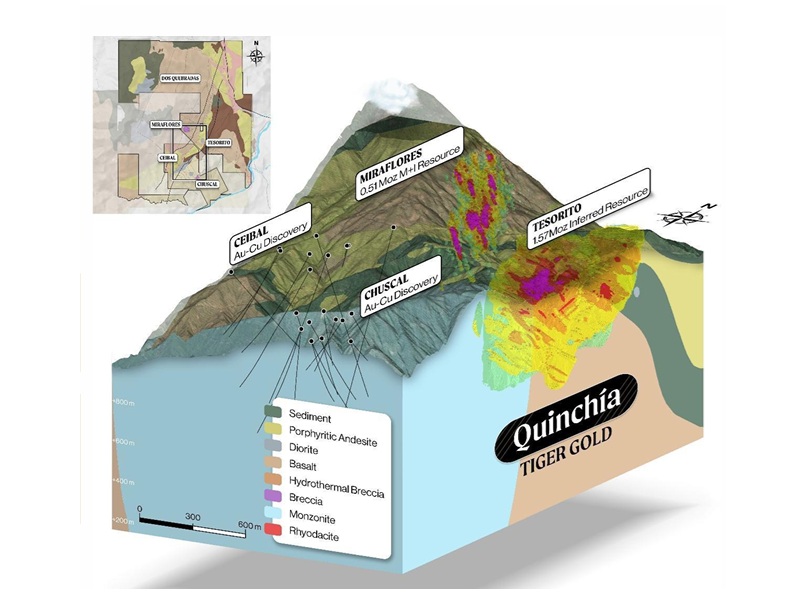
Tiger Gold (TSXV: TIGR) is advancing its flagship Quinchía Gold Project in Colombia’s prolific Mid-Cauca porphyry belt… a region where gold discovery rates are outpacing the rest of the world! Listed on the TSX Venture Exchange two months ago, the company is led by a seasoned team with over 30 years of experience from majors like Barrick and Yamana.
The Quinchía Project benefits from excellent infrastructure including paved roads, grid power, and proximity to skilled labor in the nearby town of Quinchía thereby reducing development risks and costs. It’s located in an emerging tier-1 jurisdiction with a stable permitting framework, as evidenced by the project’s partial permitting.
Quinchía sits 20 km south of Aris Mining’s (TSX: ARIS) producing Marmato Gold Mine (~6.2 million oz resource, targeting 500,000 oz/year). Other notable nearby projects include:
- AngloGold Ashanti (AU)’s Nuevo Chaquiro copper–gold deposit (~7 million oz Au equivalent, in development).
- B2Gold (BTG)’s Gramalote gold project (~5.5 million oz resource, advancing toward construction).
- Zijin Mining (HK: 2899)’s producing Buriticá Gold Mine (~5.32 million oz resource, high-grade underground operation).
TIGR’s Quinchía Project has similarities in geology to neighbors like Collective Mining (CNL)’s Apollo deposit.
The Quinchía Project hosts three known gold deposits, with two of them (Tesorito and Miraflores) forming the backbone of TIGR’s 2025 Preliminary Economic Assessment (PEA). Together, Tesorito and Miraflores host ~2.08 million oz in current NI 43-101 compliant gold resources, with significant upside from ongoing drilling.
-
Tesorito: An open-pittable porphyry deposit with ~1.57 million oz inferred gold. It accounts for ~80% of the PEA’s value and features a high-grade core open at depth and on strike.
-
Miraflores: An adjacent high-grade underground deposit with ~510,000 oz measured & indicated gold. Fully permitted for small-scale construction and operation, it serves as a “major enabler” for project-wide permitting modifications, fast-tracking expansions.
-
Dos Quebradas: Located ~2 km north of Tesorito and Miraflores, with a historical JORC-compliant resource of ~495,000 oz gold. Not yet NI 43-101 compliant and excluded from the PEA due to insufficient drilling maturity. The CEO views it as “low-hanging fruit,” with geologists believing prior models undervalued it. TIGR sees potential to grow it to ~1.5 million oz through redrilling.
Beyond these, high-priority exploration targets like Ceibal and Chuscal show “massive footprints“ with early drilling indicating continuous mineralization (>500m depths at ~0.5-0.8 g/t Au, plus copper). These could connect to the main deposits, supporting a conservative pathway to doubling resources to ~4 million oz.
TIGR’s 2025 PEA outlines a robust base case for a 20,000 tpd open-pit/underground operation producing ~140,000 oz gold annually over 10 years. At US$4,600 per oz gold with a 5% discount rate, the Quinchía Gold Project has an after-tax Net Present Value (NPV) of US$1.75 billion with initial capex of only US$480 million.
This is a foundational launchpad with drilling aimed at expanding scope and improving grades/recoveries for TIGR’s pre-feasibility and a construction decision next year.
TIGR is executing a fully funded ~20,000m 2026 drill program in 10,000m phases to define the project’s full scale. Three diamond rigs are active:
- Two at Tesorito: One for infill (upgrading inferred resources to measured & indicated); one for resource expansion.
- One at Dos Quebradas: Redrilling to upgrade the historical resource of ~495,000 oz to NI 43-101 compliance while potentially revealing a larger, more lucrative deposit with surface reaching high-grade cores.
Assays of the first hole at Dos Quebradas are pending (second drill hole underway). TIGR’s different approach could rewrite the book on this undervalued asset.
Yesterday, TIGR announced the discovery of a potential high-grade feeder zone at Tesorito.
-
TSDH-71: Intersected 89.96m @ 0.9 g/t Au (from 426m), below the current mineral resource estimate. A standout sub-interval: 16.9m @ 2.3 g/t Au, 0.25% Cu, and 158 ppm Mo (including 6m @ 4.1 g/t Au, 0.43% Cu, and 302 ppm Mo). This “not typical” Au-Cu-Mo style suggests a feeder zone for the porphyry system… a potential gamechanger with substantially higher-than-modelled grades. Follow-up hole TSDH-80 is underway to test down-dip extensions.
-
TSDH-70: Confirmed shallow eastern margin with 79m @ 0.6 g/t Au (from 2m), filling a sparsely drilled area.
Previously announced intercepts from recent weeks highlight Tesorito’s consistency:
- TSDH-74: 191.2m @ 0.6 g/t Au (from 22.8m).
- TSDH-72: 73.6m @ 0.5 g/t Au (from surface) and 65m @ 0.7 g/t Au (from 85m).
- TSDH-73: 125.35m @ 0.4 g/t Au (from 60m; ended in mineralization).
- TSDH-69: 307.1m @ 0.7 g/t Au (from 8m).
- TSDH-68: 139.6m @ 0.9 g/t Au (from 0.8m).
- TSDH-67: 68m @ 0.7 g/t Au (from surface), plus intervals of 18m @ 0.5 g/t Au and 60m @ 0.7 g/t Au.
Assays are pending from three completed Tesorito holes, including TSDH-78 (above yesterday’s high-grade feeder zone discovery hole TSDH-71, showing similar porphyry-style features). Two more holes are drilling now.
TIGR’s market cap at $0.79 per share is only US$59.97 million or US$28.83 per oz of total current NI 43-101 compliant gold resources, making it one of the world’s most undervalued gold exploration companies! TIGR management and insiders own 22% of the company!
Past performance is not indicative of future results. NIA is not an investment advisor and does not provide investment advice. Always do your own research and make your own investment decisions. NIA has received US$100,000 cash from TIGR for a twelve-month marketing contract. NIA previously received US$50,000 cash from ARIS for a six-month marketing contract which has expired. This communication is for informational and educational purposes only.