AWCM: Porphyry Discovery Potential
Ameriwest Critical Metals (CSE: AWCM) gained by 16.22% today to $0.215 per share.
If you look at AWCM’s press release from yesterday with the first modern assay results of historical drill core from their 100%-owned high-grade Bornite Copper Project in Oregon, they are calculating “copper equivalent“ using assumed prices of copper $6.40 per lb, gold $4,500 per oz, and silver $75 per oz, with recoveries of copper 95%, gold 90%, and silver 95%, using the formula: CuEq grade = (Cu grade) + (45.67641 x Au grade) + (0.80357 x Ag grade).
AWCM’s Bornite Copper Project has a historical non-NI 43-101 resource estimate from the previous operator Plexus Resources/Kinross Copper using a cutoff of 0.50% copper of about 3.2 million short tons (equal to ~2.90 Mt) averaging 2.2% copper, plus 0.017 oz/t gold and 0.54 oz/t silver. That represented roughly 138.5 million lb copper, 54,000 oz gold and 1.7 million oz silver.
Using the same assumed prices, recoveries, and formula from yesterday’s press release: AWCM’s Bornite Copper Project has a historical non-NI 43-101 resource estimate of about 3.2 million short tons (equal to ~2.90 Mt) averaging 3.41% CuEq for 218.3 million lbs of copper equivalent.
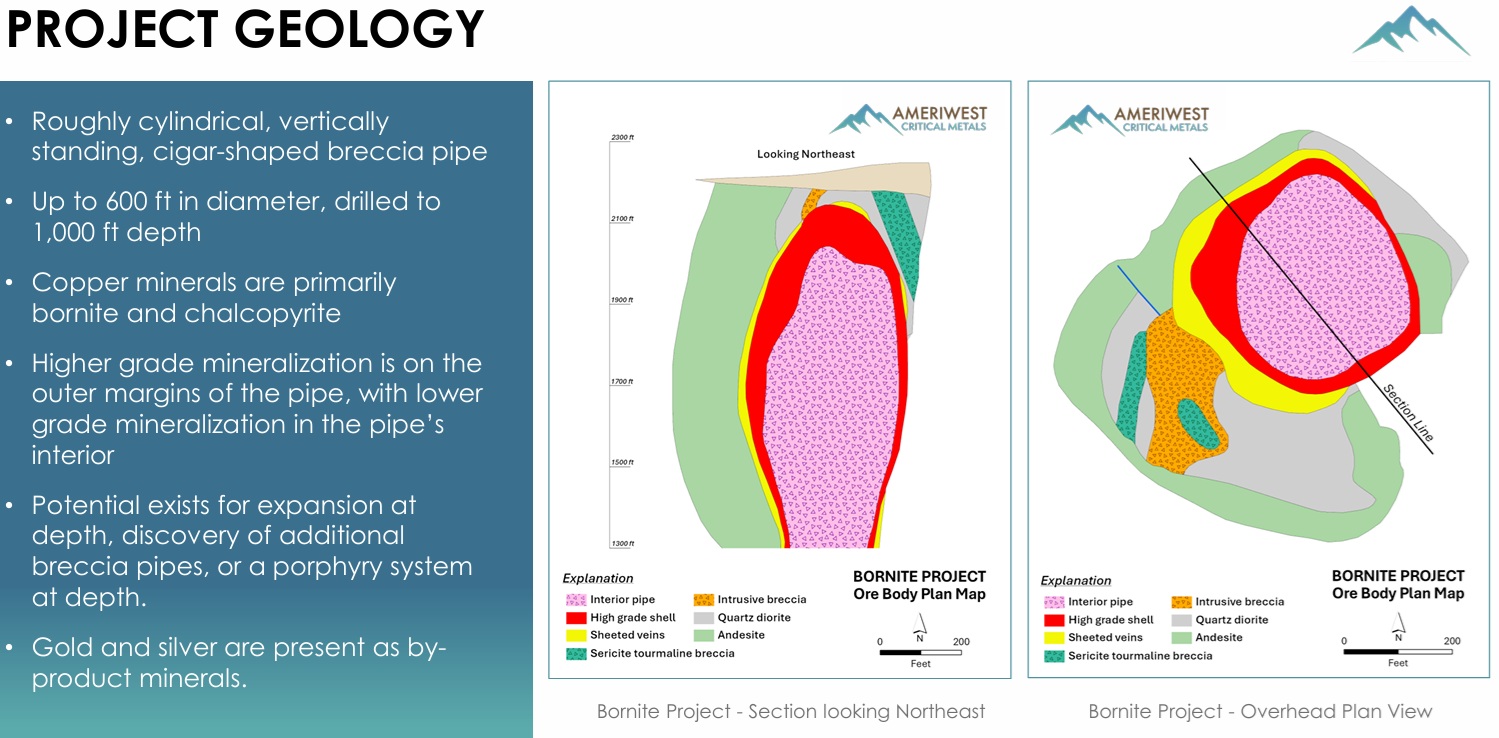
Importantly, historical drilling focused on the original Bornite Pipe, with the historical resource derived primarily from its high-grade outer shell and sheeted vein zone of the Bornite Pipe. Much of the lower-grade interior was excluded under the historical 0.50% copper cutoff. With copper trading many times above its early-1990s price, this previously overlooked interior could offer significant potential to expand Bornite’s resource tonnage and potentially support a much larger, bulk-mining operation!
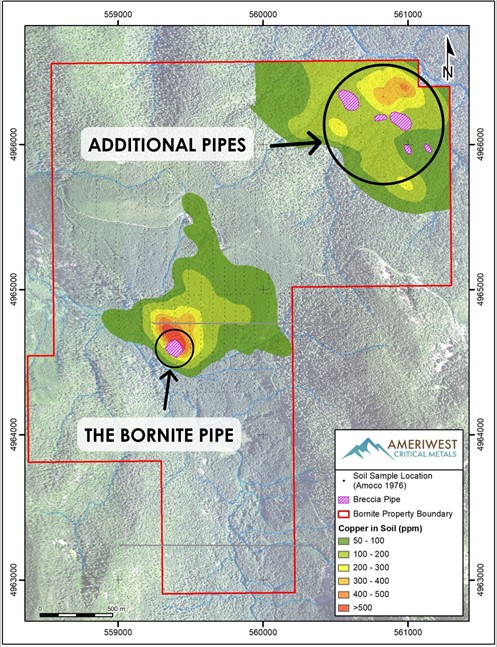
Even more exciting, five additional potentially mineralized breccia pipes have been identified but remain untested by drilling, offering substantial exploration upside beyond the original Bornite Pipe!
NIA’s President has studied many of the books and research reports published by legendary exploration geologist J. David Lowell, who discovered more porphyry copper deposits than any other geologist in world history. Lowell frequently wrote about mineralized breccia pipes and their relationship to porphyry copper systems. In August 1961, Lowell published a research paper titled ‘Geology and Origin of Mineralized Breccia Pipes in Copper Basin, Arizona’, which explained how mineralized breccia pipes can serve as conduits for copper-rich hydrothermal fluids associated with larger porphyry copper systems.
In other words: breccia pipes often act as the chimneys for larger porphyry copper systems at depth.
The Bornite Pipe’s copper minerals are primarily bornite and chalcopyrite, which just so happen to be the two most common and economically vital primary copper minerals found in porphyry deposits.
The Bornite Pipe remains open at depth. They stopped drilling at about the 1,000-foot (305-meter) level.
Past performance is not indicative of future results. NIA is not an investment advisor and does not provide investment advice. Always do your own research and make your own investment decisions. NIA’s President has purchased 240,000 shares of AWCM in a private placement and owns 240,000 AWCM warrants to buy more shares. NIA is receiving compensation from AWCM of US$100,000 cash for a twelve-month marketing contract. This communication is for informational and educational purposes only.