Dysprosium in North America: Volta and Saga Could Have Two Most Important Projects
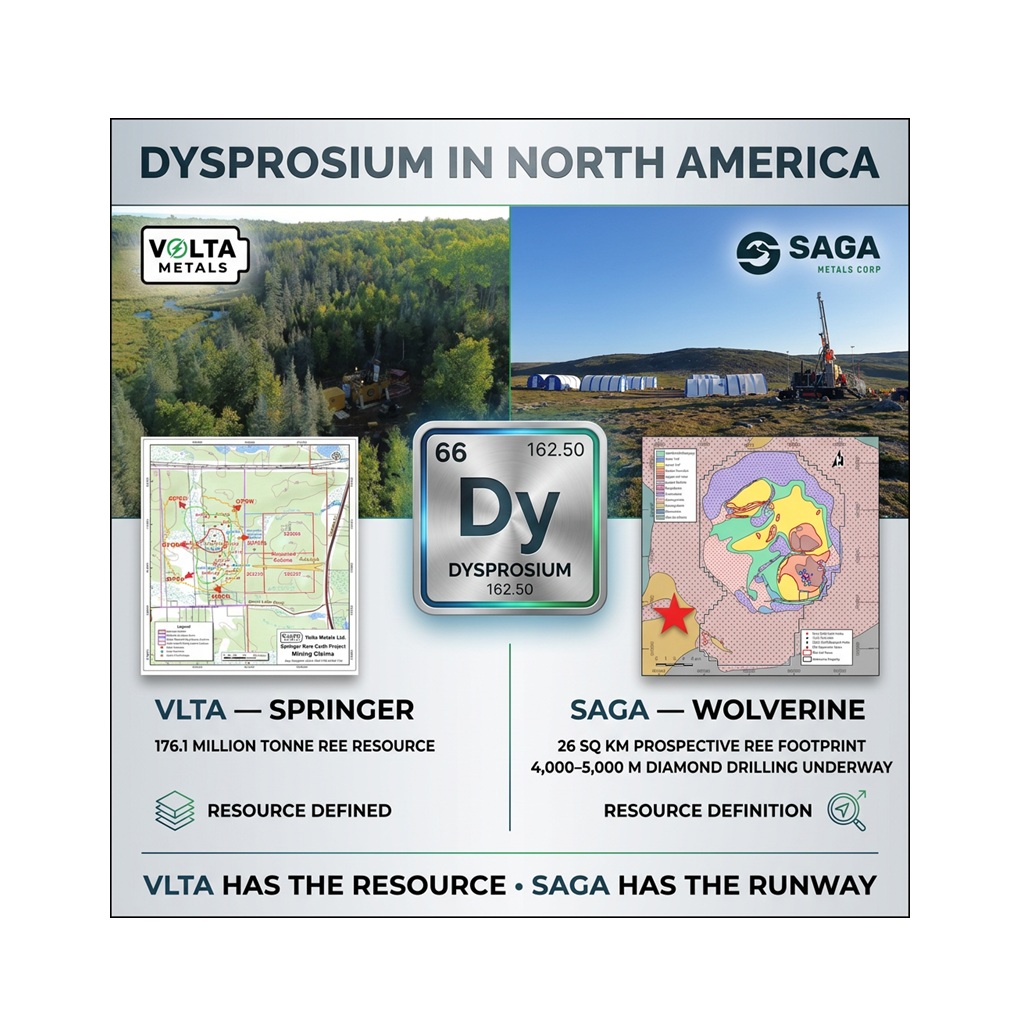
Dysprosium (Dy) could become one of the most important and valuable Rare Earth Elements of the coming decade. Dysprosium is an important ingredient in high-performance neodymium-iron-boron (NdFeB) permanent magnets, where it can help magnets maintain their performance at high temperatures. These powerful permanent magnets are critical to applications including electric vehicle motors, wind turbines, advanced electronics, industrial equipment, and defense technologies.
The challenge is that dysprosium is one of the more difficult critical minerals for North America to source domestically. This makes the discovery and development of large-scale North American REE projects containing meaningful dysprosium increasingly important.
NIA believes investors looking for exposure to dysprosium in North America should be paying extremely close attention to both Volta Metals (CSE: VLTA) and Saga Metals (TSXV: SAGA). The two companies are at different stages of exploration and resource definition, but they could potentially be advancing North America’s most important dysprosium-bearing REE projects.
Volta Metals (CSE: VLTA) provides an important example of how quickly successful drilling can transform the scale of an REE project. VLTA began its inaugural drilling program at its Springer REE Project in September 2025 and today has a current NI 43-101 Mineral Resource Estimate containing 56.6 million tonnes Indicated at 0.70% TREO plus another 119.5 million tonnes Inferred at 0.58% TREO, for a combined 176.1 million tonnes of REE mineralization.
Importantly, Springer contains dysprosium. VLTA’s current resource averages 38 ppm Dy₂O₃ in the Indicated category and 31 ppm Dy₂O₃ in the Inferred category, equivalent to approximately 33.1 ppm and 27.0 ppm elemental dysprosium, respectively.
Some of VLTA’s individual drill intercepts have contained much higher dysprosium grades. Drill hole SL25-24 returned 27.1 metres averaging 157.8 ppm Dy₂O₃, equivalent to approximately 137.5 ppm elemental Dy. This provides investors with an important real-world benchmark for what 100+ ppm elemental dysprosium can look like when encountered over a meaningful drill width within a large REE system.
VLTA’s success is particularly relevant when evaluating Saga Metals (TSXV: SAGA) because SAGA is approximately one major drilling cycle behind VLTA at its Wolverine Heavy Rare Earth Project in Labrador.
Prior to SAGA acquiring Wolverine, only 817.4 metres of shallow RC drilling across 25 holes had been completed in 2025. Despite this extremely limited amount of drilling, 19 of the 25 RC holes returned mineralized intercepts exceeding 0.2% TREO, and the drilling confirmed broad, near-surface mineralization across an approximately 1.7 km by 1.2 km area.
Some of the most important 2025 RC results included:
- WOLRC25-003: 48.8 m @ 0.77% TREO from 1.5 m, including 18.3 m @ 1.06% TREO
- WOLRC25-006: 38.1 m @ 0.71% TREO from surface, including 4.6 m @ 1.53% TREO
- WOLRC25-002: 51.8 m @ 0.52% TREO from surface, including 33.5 m @ 0.67% TREO
Peak RC sample grades reached 2.03% TREO, while the mineralization demonstrated an average Heavy Rare Earth Oxide (HREO) contribution of approximately 24-28%. SAGA has said that these results demonstrated sufficient scale and continuity to justify advancing Wolverine toward NI 43-101 resource definition.
That is exactly what SAGA is now attempting to accomplish. The company has begun an initial 4,000-5,000 metre diamond drilling program designed to confirm vertical grade continuity, test the thickness of the mineralized horizon, collect metallurgical material, and advance Wolverine toward a maiden NI 43-101 Mineral Resource Estimate.
In other words, investors shouldn’t compare VLTA’s current 176.1-million-tonne resource against SAGA’s current absence of a resource without considering the enormous difference in the amount and type of drilling completed to date. VLTA has already gone through the drilling and resource-definition process that SAGA is only now beginning.
What makes SAGA particularly interesting to NIA is what Wolverine has already demonstrated from only 817.4 metres of shallow RC drilling combined with what the company’s first deeper diamond drilling is now revealing.
SAGA’s very first 2026 diamond hole, W26-001, intersected an extraordinary 169 metres of prospective REE-bearing volcanic ash tuff. SAGA has described this location as being at the cool, upper end of the feeder, raising the possibility that different or potentially higher-grade REE mineralization could occur deeper within the system.
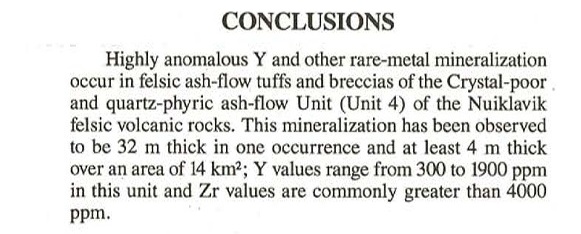
Scientists reported as far back as 1993 that the Wolverine Heavy Rare Earth Project, then known as Nuiklavik, contained rare-metal mineralization that was 32 metres thick in one occurrence and at least 4 metres thick over an area of 14 square kilometres:
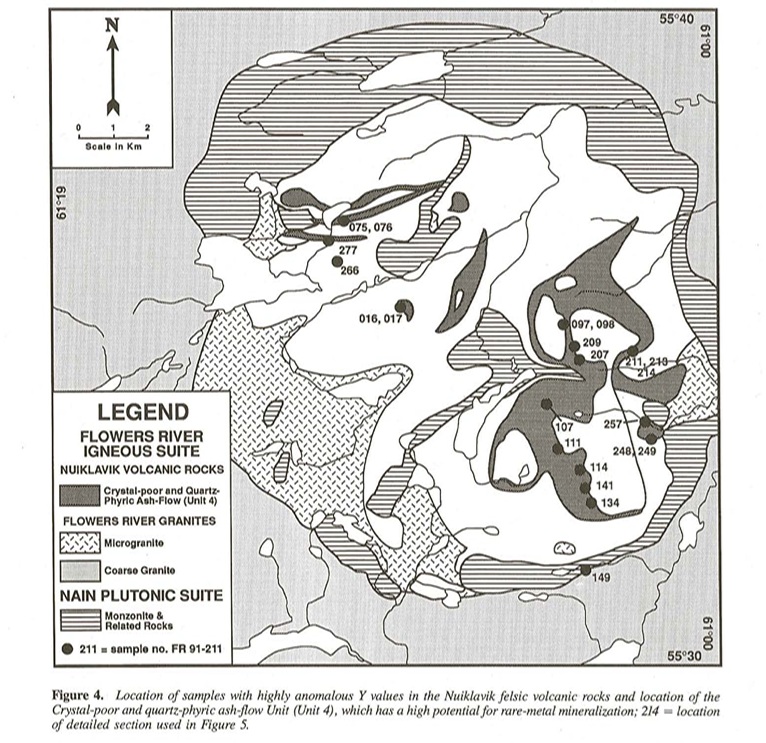
Today, the broader prospective REE-bearing ash-flow footprint at Wolverine covers approximately 26 sq km. Only a small portion of this enormous system has been drill tested.
This distinction is extremely important when comparing the long-term potential of SAGA and VLTA. VLTA’s current Springer resource is already very large at 176.1 million tonnes and remains open for expansion. VLTA itself believes Springer has the potential to grow further, so NIA is certainly not suggesting Springer’s resource has reached its ultimate size.
However, NIA believes SAGA’s exploration upside could ultimately be even larger. Wolverine’s prospective REE-bearing system covers approximately 26 square kilometres, while drilling to date has tested only a small portion of it. If SAGA’s ongoing and future diamond drilling confirms that the thickness, grade, and continuity demonstrated by the early drilling extend across substantial portions of this footprint, Wolverine could ultimately support a resource materially larger than what has currently been defined at Springer.
This is an NIA exploration thesis, not a current mineral resource estimate. SAGA must complete substantially more drilling, receive assays, conduct the necessary geological modelling, and satisfy NI 43-101 requirements before the size of a Wolverine resource can be established.
In the nearer term, however, NIA believes it is reasonable to consider whether SAGA’s current 4,000-5,000 metre diamond program, combined with the successful 817.4 metres of previous RC drilling, could establish a maiden resource with a scale that begins to approach other major North American REE projects such as Springer. Whether Wolverine ultimately matches or exceeds Springer’s current 176.1 million tonnes will be determined by drilling and cannot yet be known.
The important point for investors is that SAGA does not need Wolverine to already have a 176.1-million-tonne resource today. VLTA didn’t begin its inaugural Springer drilling program until approximately one year ago. SAGA is now undertaking the type of substantial diamond drilling program that could allow the market to begin understanding Wolverine on a comparable resource basis.
Dysprosium makes this potential scale particularly interesting.
NIA has the full database of historical samples taken from the Wolverine Heavy Rare Earth Project. From what we see, all 249 historical samples in the database taken across SAGA’s 26 sq km REE ash-flow footprint contain dysprosium.
Most interestingly, SAGA’s first two 2026 diamond drill holes were completed in close proximity to historical samples containing some of the project’s highest dysprosium grades:
- Historical sample 114: 168.6 ppm Dy
- Historical sample 141: 334.2 ppm Dy
- Historical sample 134: 192.8 ppm Dy
These are elemental Dy grades. For perspective, VLTA’s exceptional 27.1-metre interval averaging 157.8 ppm Dy₂O₃ is equivalent to approximately 137.5 ppm elemental Dy.
It is important to emphasize that SAGA’s historical values are surface samples whereas VLTA’s 27.1-metre result is a drill intercept average. They therefore cannot be treated as directly equivalent evidence. The significance of the historical Wolverine samples is that they demonstrate the presence of very high dysprosium concentrations within the geological system. The assays from SAGA’s ongoing diamond program will determine whether elevated Dy grades continue across meaningful widths at depth.
The following photo isn’t even part of SAGA’s main 26 sq km REE ash-flow footprint. It shows a separate area of the broader Wolverine Project where surface samples returned grades as high as 21.6% TREO.
One of these samples contained an extraordinary 2,980 ppm dysprosium, while other samples from the same showing contained 2,570 ppm Dy and 3,550 ppm Dy. Again, these are surface grab samples and aren’t representative of average grades across Wolverine, but they provide additional evidence of the extraordinary degree to which dysprosium can become enriched within the broader geological system.
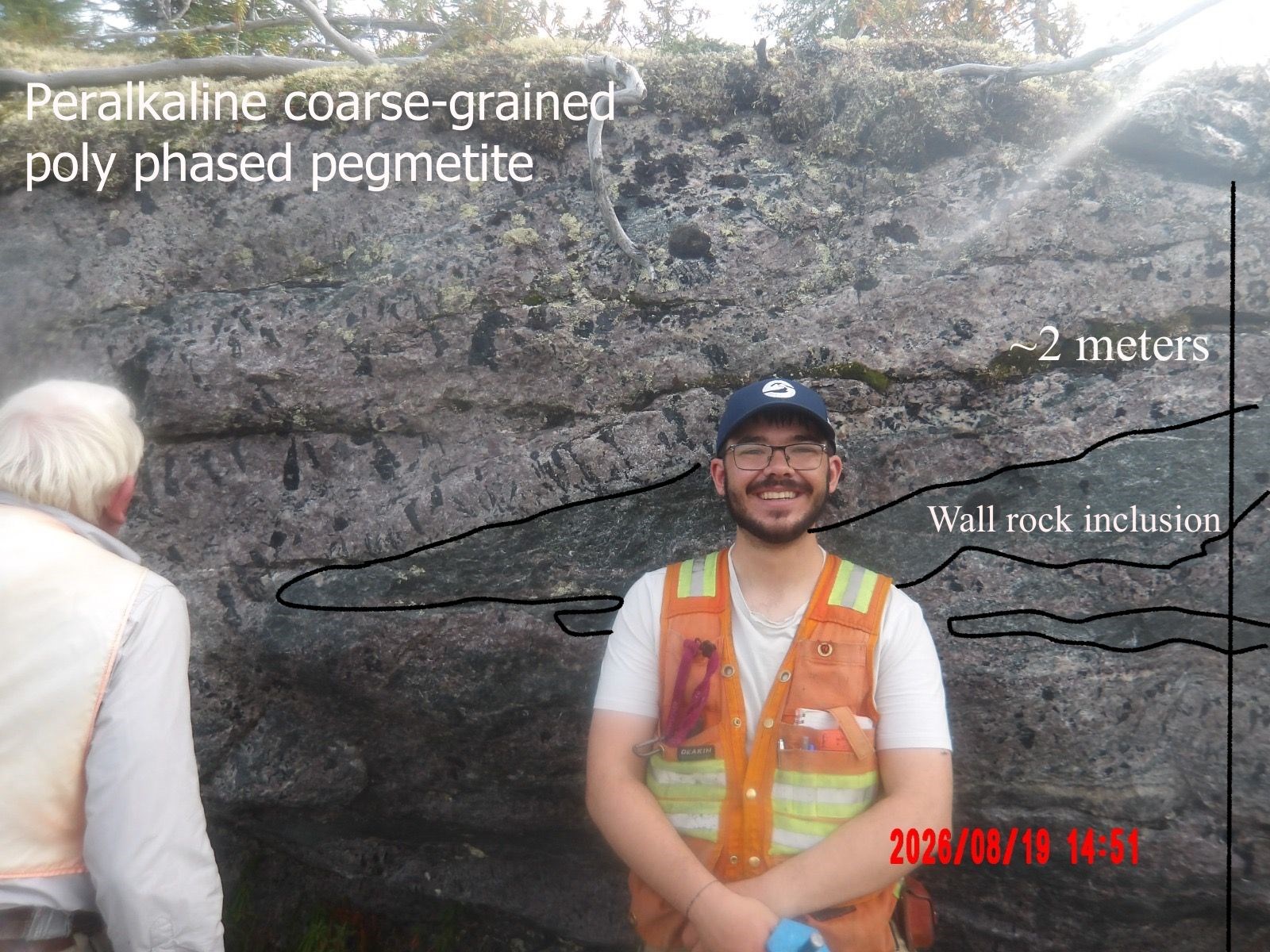
SAGA’s rocks at Wolverine are among the oldest in the world. These rocks were once geographically connected with Greenland, which hosts some of the world’s largest known REE deposits.
Another excellent example of why investors should pay close attention to dysprosium grades is USA Rare Earth (USAR)’s Round Top Project. Round Top’s historical REE resource contains approximately 31.7 ppm dysprosium in its Measured & Indicated resource. A USA Rare Earth management presentation described Round Top as being “uniquely rich in dysprosium” and stated that dysprosium represented approximately 46% of the project’s rare earth value.
This illustrates why simply looking at total TREO grade doesn’t tell investors the full story. A relatively small percentage of an REE deposit by weight can potentially account for a disproportionately large percentage of its economic value when that percentage consists of high-value magnet rare earths such as dysprosium.
This is what makes both VLTA’s Springer and SAGA’s Wolverine so interesting. VLTA has already demonstrated what successful drilling can accomplish: in approximately one year, Springer has emerged with a 176.1-million-tonne NI 43-101 resource containing meaningful dysprosium, while additional drilling indicates that the system remains open for further expansion.
SAGA is earlier in the same process. Wolverine currently has no mineral resource estimate, but only 817.4 metres of shallow RC drilling had been completed before the current diamond program began. That limited drilling already established broad REE mineralization, significant Heavy Rare Earth enrichment, and continuity across a substantial area. SAGA is now adding 4,000-5,000 metres of diamond drilling while testing a system whose overall prospective footprint is far larger than the portion drilled to date.
For this reason, while VLTA currently has the advantage of a defined resource, NIA believes SAGA could potentially have the greater exploration upside. In NIA’s view, the question isn’t whether Wolverine already has a resource comparable to Springer… it clearly does not because the necessary drilling and resource estimation haven’t yet been completed. The question is what Wolverine could look like after SAGA completes the type of drilling that allowed Springer to establish and rapidly expand its own resource.
If SAGA’s ongoing drilling successfully demonstrates continuity across Wolverine’s prospective REE-bearing system, NIA believes the project has the geological scale to potentially become substantially larger over the long term than its initial maiden resource ultimately defines.
Past performance is not an indicator of future returns. NIA is not an investment advisor and does not provide investment advice. Always do your own research and make your own investment decisions. NIA has received compensation from SAGA of US$100,000 cash for a twelve-month marketing contract. This message is meant for informational and educational purposes only and does not provide investment advice.