305.55m Gold Hit Changes Everything at Tiger Gold (TIGR)
Tiger Gold Intersects 305.55 m @ 0.5 g/t Au at Tesorito, Including 15.7 m @ 1.1 g/t Au and 8 m @ 1.3 g/t Au
Vancouver, British Columbia — Tiger Gold Corp. (TSXV: TIGR) (FSE: D150) (OTCQB: TGRGF) (“Tiger” or the “Company”) is pleased to report assay results from its ongoing diamond drilling campaign at the Tesorito deposit at its Quinchía Gold Project in Colombia’s prolific Mid-Cauca gold belt. Drilling at Tesorito forms part of Tiger’s broader 20,000-metre drill program, which is ongoing with three diamond drill rigs active across the project.
Highlights
- TSDH-80 intersected 15.7 m @ 1.1 g/t Au and 8 m @ 1.3 g/t Au, 0.16% Cu, and 131 ppm Mo within 305.55 m @ 0.5 g/t Au from 516 m downhole.
- The 8 m sub-interval may represent an offset of the potential feeder-style structure encountered in TSDH-71.
- The potential feeder-style structure remains a priority target for follow-up drilling.
- The 305.55 m interval represents a substantial mineralized porphyry envelope, extending drill-tested gold mineralization below the 2025 Mineral Resource conceptual pit shell.
- Additional assay results are pending from drillholes at Tesorito, Dos Quebradas, and Ceibal.
“TSDH-80 returned 305.55 m at 0.5 g/t Au at Tesorito below the 2025 Mineral Resource conceptual pit shell, with an 8 m higher-grade interval that may be a continuation of the potential feeder zone we hit in TSDH-71. These results add to our geologic understanding beneath the current resource. We’ll plan additional follow-up once results come in from the next section line north of TSDH-71, which we expect to assist in our evolving interpretation and inform future drilling.”
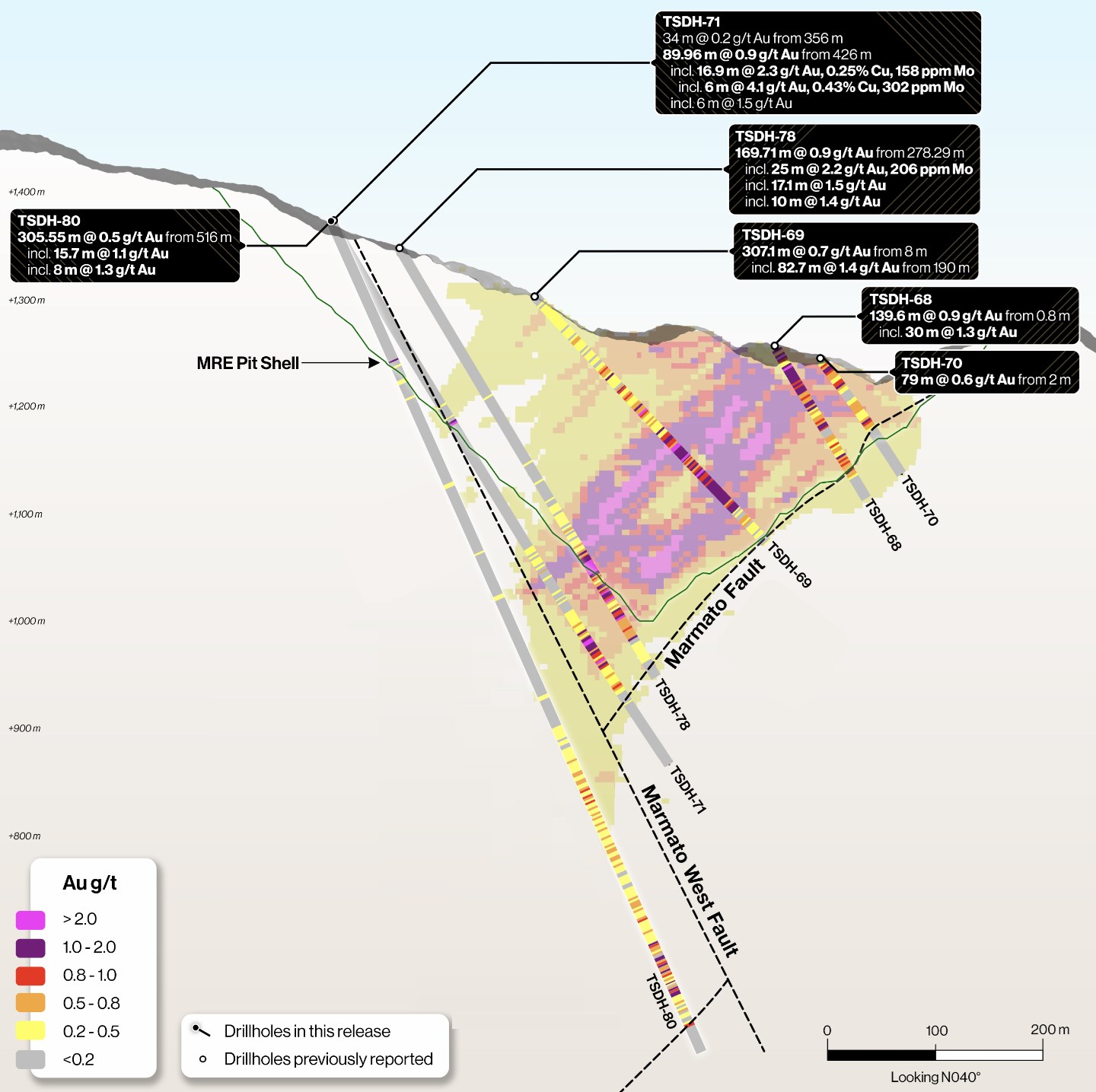
Drilling results for TSDH-80 are summarized in Tables 1 and 2. Figure 1 shows the location of the reported drillhole. Figure 2 presents a cross section through drillholes TSDH-68 to TSDH-71, TSDH-78, and TSDH-80. Results for these holes were previously reported in Tiger news releases dated January 20, January 29, February 18, February 24, and April 16, 2026. Figure 3 is a map of the Quinchía Gold Project.
TSDH-80 Returns Broad Gold Mineralization and Refines the Feeder Targeting Model
TSDH-80 was collared from the same pad as TSDH-71 (Figure 1) and drilled at a steeper angle than TSDH-71 to reach greater depth and test for the expected continuation of the potential feeder-style structure encountered in TSDH-71 (Figure 2). As reported on February 24, 2026, TSDH-71 returned 89.96 m grading 0.9 g/t Au, including 16.9 m grading 2.3 g/t Au, 0.25% Cu, and 158 ppm Mo, including 6 m grading 4.1 g/t Au, 0.43% Cu, and 302 ppm Mo, which the Company interprets as a potential feeder-style mineralizing event (Table 3).
From surface to approximately 185 m the hole passed through colluvium and basalt, which were not meaningfully mineralized, consistent with the Company’s models. Below that, the hole entered porphyritic andesite that returned 15.7 m grading 1.1 g/t Au and 8 m grading 1.3 g/t Au, 0.16% Cu, and 131 ppm Mo (Table 1) within a broader intercept of 305.55 m grading 0.5 g/t Au from 516 m downhole.
The 305.55 m interval was encountered substantially deeper than the Company had expected based upon its geological model at the time of drilling. The Company interprets this deeper-than-expected starting position to an offset of the mineralized system (Figure 2). The displacement interpretation is supported by TSDH-80’s intersection with Marmato Fault near the bottom of the hole that is still being evaluated.
The 8 m sub-interval is hosted within a deeper sequence of intrusive breccia and early-stage diorite that appears similar to the package that hosts the TSDH-71 potential feeder interval. Its copper and molybdenum grades are several times higher than the average copper and molybdenum grades of composite intervals elsewhere at Tesorito. The Company interprets the 8 m sub-interval as potentially representing the offset continuation of the same potential feeder-style structure encountered in TSDH-71.
Following review and integration of results from the drill section line to the north of TSDH-71, the Company plans to follow up the potential feeder zone target with additional drilling. The Company expects this will assist in its evolving interpretation and inform future drilling.
Drilling of TSDH-80 was affected by a short core-loss interval at approximately 612 m and by the downhole loss of drilling rods, bits, and tools, which together prevented continuation of the parent hole beyond approximately 626 m. A wedge (TSDH-80-W1) was kicked off at approximately 615 m and drilled at an azimuth of N132° and an inclination of -63° to a final depth of 847.7 m. Assay results reported in Table 1 are presented as a continuous run.
Table 1: TSDH-80 Assay Results
| Drillhole ID | From (m) | To (m) | Interval (m) | True Width (m) | Au (g/t) | Ag (g/t) | Cu (%) | Mo (ppm) |
|---|---|---|---|---|---|---|---|---|
| TSDH-80 | 516 | 821.55 | 305.55 | 252.6 | 0.5 | 0.6 | 0.05 | 43 |
| incl. | 750.3 | 766 | 15.7 | Unknown | 1.1 | 0.5 | 0.06 | 68 |
| incl. | 782 | 790 | 8 | Unknown | 1.3 | 1.4 | 0.16 | 131 |
• All composite intervals are reported over a minimum downhole length of 10 m at a minimum length-weighted grade of 0.2 g/t Au, allowing for up to 10 m of consecutive internal dilution below cut-off.
• All reported intervals refer to downhole core lengths. True width estimates are based upon the Company’s current interpretation.
• Higher-grade intervals reported as any interval over a minimum length of 5 m at a minimum length-weighted grade of 1 g/t Au, allowing for up to 5 m of consecutive internal dilution below cut-off. No assays were capped.
Table 2: Drillhole Collar Information (EPSG:32618)
| Drillhole ID | Easting (m) | Northing (m) | Elevation (m asl) | Length (m) | Azimuth (°) | Dip (°) |
|---|---|---|---|---|---|---|
| TSDH-80 | 423,475 | 584,655 | 1,369 | 625.9 | 131 | -65 |
| TSDH-80-W1 | 423,675 | 584,475 | 820 | 232.7 | 132 | -63 |
Table 3: TSDH-71 Assay Results (Previously Reported on February 24, 2026)
| Drillhole ID | From (m) | To (m) | Interval (m) | True Width (m) | Au (g/t) | Ag (g/t) | Cu (%) | Mo (ppm) |
|---|---|---|---|---|---|---|---|---|
| TSDH-71 | 356 | 390 | 34 | 29.7 | 0.2 | 0.6 | 0.02 | 16 |
| and | 426 | 515.96 | 89.96 | 79.0 | 0.9 | 1.0 | 0.08 | 57 |
| incl. | 455.1 | 472 | 16.9 | Unknown | 2.3 | 2.0 | 0.25 | 158 |
| incl. | 456 | 462 | 6 | Unknown | 4.1 | 3.5 | 0.43 | 302 |
| incl. | 480 | 486 | 6 | 5.3 | 1.5 | 1.6 | 0.12 | 41 |
• All composite intervals are reported over a minimum downhole length of 10 m at a minimum length-weighted grade of 0.2 g/t Au, allowing for up to 10 m of consecutive internal dilution below cut-off.
• All reported intervals refer to downhole core lengths. True width estimates are based upon the Company’s current interpretation.
• Higher-grade intervals reported as any interval over a minimum length of 5 m at a minimum length-weighted grade of 1 g/t Au, allowing for up to 5 m of consecutive internal dilution below cut-off. No assays were capped.

Figure 1: Tesorito Drillhole Collar and Section Locations Plan Map
Figure 2: Tesorito Section A-A’ (looking N040°)

Figure 3: Quinchía Gold Project Deposits and Prospects
Mineral Resources and Technical Report
A report titled Quinchía Gold Project NI 43-101 Technical Report & Preliminary Economic Assessment, Department of Risaralda, Colombia (effective September 18, 2025) (the “Technical Report”) was filed on SEDAR+ on December 10, 2025. The Technical Report also supports the disclosure of Mineral Resource estimates for the Miraflores and Tesorito deposits with an effective date of July 31, 2025. Mineral Resources that are not Mineral Reserves do not have demonstrated economic viability.
Sampling, Quality Assurance and Quality Control
All drilling was completed using HQ- and NQ-diameter diamond core. Drill core is logged by a Company geologist, photographed, and cut in half at the Company’s core facility in Quinchía, Colombia. One half of the core is bagged and sent to ALS’ laboratory in Medellín for sample preparation and with sub-samples sent to ALS’ laboratories in Lima, Perú or North Vancouver, British Columbia for analysis. The remaining half-core (or quarter-core if a duplicate sample was taken) is retained onsite as a witness sample. ALS’ Medellín, Lima, and North Vancouver laboratories are ISO/IEC 17025 accredited and are independent of the Company. All samples are analyzed for gold using 50 g fire assay with AAS finish (Au-AA26). Samples are also analyzed for a 48-element suite by ICP-AES and ICP-MS following a four-acid digestion (ME-MS61L). Where applicable, high-grade and overlimit assays are re-analyzed using an appropriate technique. In addition to the laboratory’s QA/QC practices, certified reference materials, coarse blanks, and quarter-core duplicates are inserted into the sample stream to monitor analytical performance. Other than as reported in this news release, no unreported significant core recovery or drilling issues were encountered during the program. Collar coordinates are preliminary and were recorded in the field using handheld GPS with elevation derived from a 2025 airborne LiDAR survey. Drill core was orientated, and downhole orientation surveys were collected at regular intervals. Only results that meet Tiger’s QA/QC protocols are reported.
Qualified Person
The pertinent scientific and technical information contained in this release has been reviewed and approved by Jeremy Link, M.Eng., P.Eng., Tiger’s Vice-President, Corporate Development, and César García, M.Sc., FAusIMM, the Company’s Exploration Manager in Colombia, each of whom is a “qualified person” as defined by Canadian Securities Administrators within the meaning of National Instrument 43-101 Standards of Disclosure for Mineral Projects (“NI 43-101”). Neither Mr. Link nor Mr. García is independent of the Company. Drill programs at Tesorito are designed by Ivor W. O. Jones, M.Sc., FAusIMM, P.Geo., of Aurum Consulting, who is a “qualified person” and independent of the Company, Mr. Link, and Mr. García. Exploration programs at the Quinchia Project are supervised by Mr. García.
About Tiger Gold Corp.
Tiger is a growth-oriented gold exploration and mine development company focused on advancing its flagship asset, the Quinchía Gold Project, a multi-million-ounce gold project in the prolific Mid-Cauca belt of Colombia, over which Tiger holds an option to acquire a 100% interest. Tiger is led by a multidisciplinary team of exploration geologists, mine builders, engineers, metallurgists, ESG specialists, and corporate finance professionals with a track record of exploration success, project advancement, and bringing mines into production at globally recognized mining companies including AngloGold Ashanti, Barrick Mining, Yamana Gold, Detour Gold, NewGold, Pretium Resources, and others.
For Further Information
President, CEO & Director
Tiger Gold Corp.
Investor Relations
+1 (604) 684-6730
tigr@kincommunications.com
Neither the TSX Venture Exchange nor its Regulation Services Provider (as that term is defined in the policies of the TSX Venture Exchange) accepts responsibility for the adequacy or accuracy of this news release.
Past performance is not indicative of future results. NIA is not an investment advisor and does not provide investment advice. Always do your own research and make your own investment decisions. NIA has received US$120,000 cash from TIGR for a twelve-month marketing contract. This communication is for informational and educational purposes only.