Tiger Gold Hits Potential Feeder Zone Beneath Resource
Tiger Gold Intersects Potential Feeder Zone Beneath Tesorito Mineral Resource with 16.9 m @ 2.3 g/t Au and 0.25% Cu, including 6 m @ 4.1 g/t Au and 0.43% Cu, within 89.96 m @ 0.9 g/t Au
Tuesday, February 24th, 2026 at PR Newswire
VANCOUVER, BC, Feb. 24, 2026 /CNW/ – Tiger Gold Corp. (TSXV: TIGR) (FSE: D150) (OTCQB: TGRGF) (“Tiger” or the “Company”) is pleased to report assay results from two drillholes from its ongoing diamond drilling campaign at the Tesorito deposit at its Quinchía Gold Project in Colombia. The Quinchía Gold Project is located in central Colombia’s prolific Mid-Cauca gold belt, approximately 20 kilometres south of Aris Mining’s Marmato Gold Mine and Collective Mining’s Apollo deposit.
Highlights:
- TSDH-71 intersected 89.96 m grading 0.9 g/t Au from 426 m downhole.
- Contained within this zone was a meaningful Au-Cu-Mo porphyry sub-interval of 16.9 m grading 2.3 g/t Au, 0.25% Cu, and 158 ppm Mo.
- Including 6 m grading 4.1 g/t Au, 0.43% Cu, and 302 ppm Mo.
- This mineralization is not typical of the main Tesorito deposit and may be the feeder zone.
- These intervals are beneath the current Mineral Resource and are at grades substantially higher-than-modelled and follow-up drilling has commenced with TSDH-80.
- TSDH-70 intersected 79 m at 0.6 g/t Au from 2 m downhole.
- Two rigs continue infill and extension drilling at Tesorito, with assays pending from 4 holes.
- A third rig continues drilling at Dos Quebradas, with assays from the first hole pending.
Robert Vallis, President & CEO, commented, “TSDH-71 has delivered a genuinely exciting result at depth, which was a key objective of our initial drill program at Tesorito. We intersected a robust 90-metre interval grading 0.9 g/t Au below the current Mineral Resource, including a 16.9-metre interval averaging 2.3 g/t Au with meaningful copper and molybdenum values – a mineralizing event previously not observed and may be the feeder zone for the Tesorito porphyry system. This interval speaks to the fertility and prospectivity of the Quinchía Project and provides a new high-priority target that we are following up with additional drilling now.”
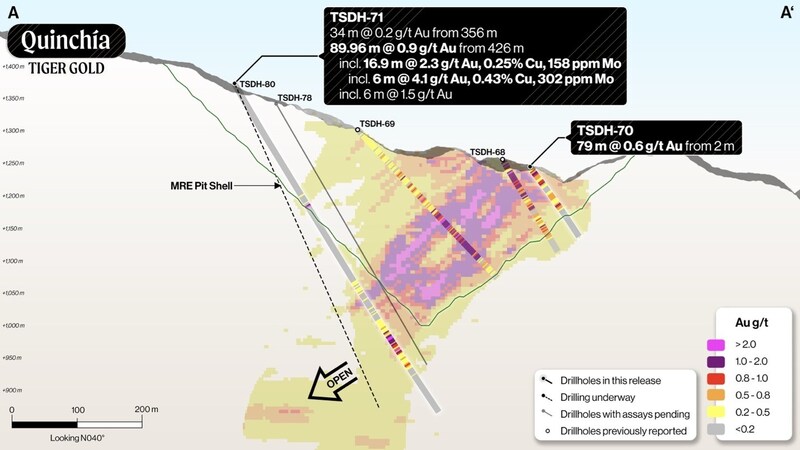
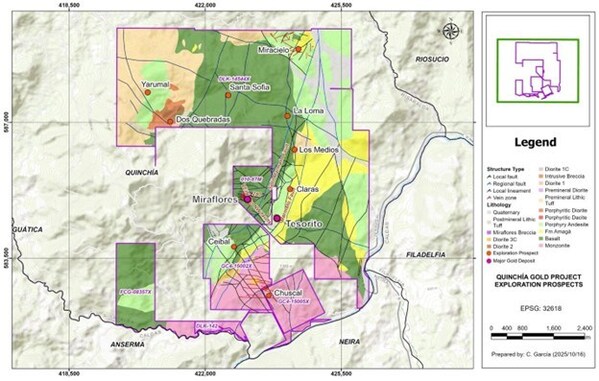
Drilling results are summarized in Table 1 and 2 near the end of this release. Figure 1 is a map of drillhole locations and Figure 2 is a cross-section of the reported results. Figure 3 is a regional map showing the deposits and high-priority prospects of the Quinchía Gold Project.
TSDH-71 Intersects Potential Feeder Zone with Follow-Up Drilling Underway
Drillhole TSDH-71 was designed to test down-dip extensions of the Tesorito block model below the base of the Mineral Resource’s conceptual pit shell, in support of potential future resource growth, and to follow up on previously identified vectors at depth. The hole intersected a broad 89.96-metre interval averaging 0.9 g/t Au below the current Mineral Resource. This interval extends to the interpreted contact with the Marmato Fault at the end of the hole.
Of particular interest within this broader interval is a 16.9-metre interval (455.1-472 m) averaging 2.3 g/t Au, 0.25% Cu, and 158 ppm Mo, including a higher-grade 6-metre interval (456-462 m) averaging 4.1 g/t Au, 0.43% Cu, and 302 ppm Mo. These copper and molybdenum grades are substantially higher than what is typically observed at Tesorito, which is characterised as a gold-dominant porphyry system with trace silver and molybdenum.
This interval coincides with the interpreted transition into an intrusive-dominated porphyry corridor, moving from the andesite into an early diorite and intrusive breccia sequence. Core logging in this section records a strong potassic alteration assemblage with moderate chlorite-sericite overprint and porphyry-style veining, including chalcopyrite-bearing veinlets with magnetite and local A-type veinlets, together with gypsum veins and copper- and molybdenum-bearing sulphides (chalcopyrite +/- molybdenite). Chalcopyrite content is estimated at 0.7% to 1.0% by volume within the early diorite and intrusive breccia, and the Company interprets this alteration and veining assemblage as the primary control on the higher-grade Au-Cu mineralization observed in this section. The Company believes these results are consistent with a distinct mineralizing event and may represent the feeder zone to the Tesorito porphyry system, which provides a new high-priority target for follow-up drilling.
Core logging from TSDH-78, drilled above TSDH-71 on the same section line, has identified an interval with similar porphyry-style mineralization and veining characteristics. Assays are pending and will be reported following receipt, quality control review, and interpretation. TSDH-80 is also underway from the same drill pad as TSDH-71 but at a steeper inclination, to test the down-dip extension of this new mineralizing event.
The Company continues to integrate these results into its exploration modelling and is advancing follow-up drilling to test the continuity, geometry, and controls of this discovery and further evaluate its significance within the broader Tesorito system.
TSDH-71 also tested a narrow down-dip extension with a modelled width of approximately 20 metres, projected to be intersected beginning at approximately 370 metres downhole. Assays through this interval indicate that the relatively higher-grade zone pinches out down-dip in this location. Importantly, this interval lies outside the current Mineral Resource estimate and is not expected to affect the estimate.
TSDH-70 Confirms Eastern Margin Continuity with 79 m at 0.6 g/t Au
Hole TSDH-70 was designed to test the shallow eastern limits of the Tesorito block model in a previously sparsely drilled area. The hole intersected 79 metres averaging 0.6 g/t Au from 2 metres downhole, confirming near-surface mineralization at the eastern margin of the system. Mineralization in the reported interval is associated with B-type quartz-magnetite-pyrite veinlets with minor chalcopyrite and is accompanied by potassic alteration with a chlorite-sericite overprint observed from approximately 26 to 79 metres downhole, consistent with the interpreted porphyry-style mineralizing system at Tesorito.
More Results Expected Shortly as Drilling Continues at Tesorito and Dos Quebradas
Drilling continues at Tesorito with two diamond drill rigs, and additional assay results are pending from three holes with two additional holes being drilled now. At Dos Quebradas, a third rig has commenced its second hole, with assays pending from the first hole. These programs reflect the Company’s strategy to systematically test high-impact targets across the Quinchía Gold Project and support potential future Mineral Resource growth.
Tesorito Drill Program Targets Resource Growth and Improved Confidence
The Tesorito drill program is designed to improve confidence in the Mineral Resource and to test margins and depth extensions to expand known mineralization. Drilling includes both step-out and infill components, with infill drilling intended to support upgrading a significant portion of the Inferred Mineral Resource to the Indicated category and advance the project towards a pre-feasibility or feasibility-level study. A summary of Mineral Resources and the Preliminary Economic Assessment (“PEA”) for the Quinchía Gold Project is provided below.
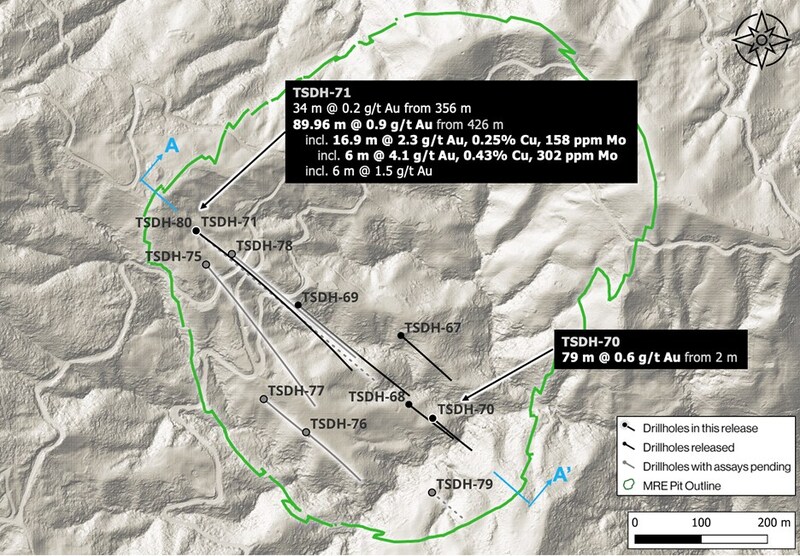
Table 1: TSDH-70 and TSDH-71 Assays Results
| Drillhole ID | From (m) | To (m) | Interval (m) | True Width (m) | Au (g/t) | Ag (g/t) | Cu (%) | Mo (ppm) |
|---|---|---|---|---|---|---|---|---|
| TSDH-70 | 2 | 81 | 79 | 71.4 | 0.6 | 1.3 | 0.07 | 20 |
| TSDH-71 | 356 | 390 | 34 | 29.7 | 0.2 | 0.6 | 0.02 | 16 |
| and | 426 | 515.96 | 89.96 | 79.0 | 0.9 | 1.0 | 0.08 | 57 |
| incl. | 455.1 | 472 | 16.9 | Unknown | 2.3 | 2.0 | 0.25 | 158 |
| incl. | 456 | 462 | 6 | Unknown | 4.1 | 3.5 | 0.43 | 302 |
| incl. | 480 | 486 | 6 | 5.3 | 1.5 | 1.6 | 0.12 | 41 |
1. All composite intervals are reported over a minimum downhole length of 10 m at a minimum length-weighted grade of 0.2 g/t Au, allowing for up to 10 m of consecutive internal dilution below cut-off.
2. All reported intervals refer to downhole core lengths. True width estimates are based upon the Company’s current interpretation.
3. Higher-grade intervals, if any, reported as any interval over a minimum length of 5 m at a minimum length-weighted grade of 1 g/t Au, allowing for up to 5 m of consecutive internal dilution below cut-off. No assays were capped.
Past performance is not indicative of future results. NIA is not an investment advisor and does not provide investment advice. Always do your own research and make your own investment decisions. NIA has received US$120,000 cash from TIGR for a twelve-month marketing contract. NIA previously received US$50,000 cash from ARIS for a six-month marketing contract which has expired. This communication is for informational and educational purposes only.