Is AI Becoming the Biggest Misallocation of Capital in History?
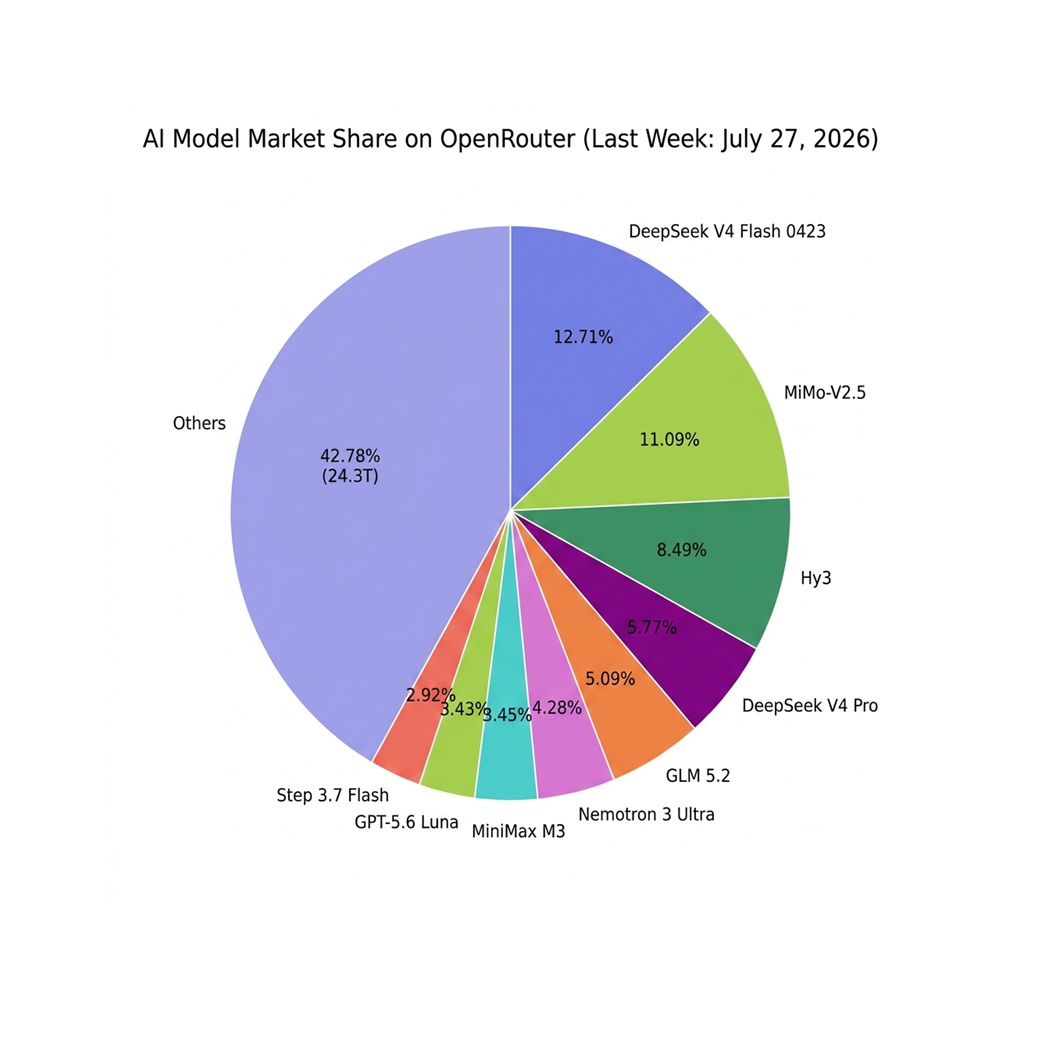
Chinese models are dominating the developer ecosystem, threatening the trillion‑dollar narratives of Anthropic and OpenAI… and the hyperscalers that bank on them. Will President Trump be forced to ban Chinese AI models and will China retaliate by banning exports to the U.S. of all critical minerals?
⚡ Key Numbers
|
DeepSeek Disrupts the Anthropic Juggernaut
Anthropic saw its private implied valuation rise to $965 billion in their May 2026 Series H Round after their Claude AI models had been dominating for several months on OpenRouter (the service that programmers use for coding). At about the same time that Anthropic closed on its $65 billion in Series H funding, the Chinese model DeepSeek V4, which had just been released a few weeks earlier… surpassed Claude on OpenRouter because it is equally as good at coding but costs 90% less. It doesn't appear to be an attempt to steal the intellectual property of U.S. businesses because these new DeepSeek models are open‑weight and available for local use on private servers without sending any data to China.
Chinese Models Now Rule the Developer Ecosystem
Last week, DeepSeek V4 Flash 0423 and DeepSeek V4 Pro had a combined 18.49% market share on OpenRouter. Shockingly, the top 5 most popular AI models were all Chinese. If we include MiMo-V2.5, Hy3, and GLM 5.2 in addition to DeepSeek V4 Flash 0423 and DeepSeek V4 Pro, the top 5 most popular AI models (all Chinese) had a combined market share of 43.16%. Anthropic Claude AI models have fallen out of the top 10. OpenAI's newly released GPT-5.6 Luna was ranked #9 with a 3.43% market share, but that was only after implementing an 80% price cut on July 30th.
The Impossible IPO Path
After the disastrous SpaceX IPO, if Anthropic and/or OpenAI went public today at $1 trillion valuations, investor appetite will be very low. However, if they don't go public, it will be impossible for them to raise the $1 trillion in funding they need between now and 2030 to cover all of the commitments made to cloud infrastructure providers.
Big Tech’s AI Revenue: A Two‑Client House of Cards
In recent weeks, big tech AI hyperscalers Microsoft (MSFT), Alphabet (GOOGL), and Amazon (AMZN) made significant gains after they each reported strong 2Q 2026 revenue growth with all of their reported growth coming from cloud-based AI services. Most people don't seem to understand that about 70% of their cloud-based AI services revenue comes from Anthropic and OpenAI.
OpenAI: Massive Losses, Free‑Tier Reality
Although OpenAI still has a 46.4% global market share in the consumer AI assistant space, roughly 95% of those users remain on the free tier with the rest paying an average of only $20 per month. OpenAI had a net loss of $38.5 billion in 2025 alone with operating expenses set to rise significantly over the next few years.
AWS: From $216 Million to a $220 Billion CAPEX Gamble
Amazon's AWS buildout was thought to be dangerously expensive at the time, as they scaled up annual corporate CAPEX from $216 million in 2006 to $979 million in 2010. AWS didn't cross into sustained profitability for Amazon until around 2013, and by that point, Amazon had poured a cumulative $11 billion+ into total company CAPEX with analysts estimating $3 billion to $5 billion went directly into AWS. But that was a smart investment for the future and led to a widely diversified customer base and huge long-term growth.
Because their CAPEX investments worked out in the past, nobody questions what Amazon is spending today, even though it is on pace to deploy a staggering $220 billion in CAPEX in 2026, with the budget recently swelling by $20 billion due to memory cost inflation. Defending the spend on an earnings call, AWS CEO Matt Garman noted:
| “Much of our capacity is already spoken for through 2027 and into 2028, and demand still significantly outstrips supply.” |
Although Amazon reported a $496 billion AWS customer backlog… the underlying data reveals unprecedented concentration risk: an estimated $238 billion (nearly half the entire backlog) is driven by just two customers: Anthropic and OpenAI.
|
Circular Vendor Financing: Between Amazon’s $33 billion commitment to Anthropic and its recent $50 billion equity injection into OpenAI, Amazon is effectively funding its own demand by forcing both AI giants into mandatory, multi‑decade AWS infrastructure agreements… but what if the compute demand is all fake? How are the Chinese models managing to do well without spending trillions of dollars on GPUs? What if OpenAI and Anthropic can't make good on their $1 trillion in commitments? Will President Trump need to ban Americans from using Chinese models? Will China ban exports of all critical minerals to the United States? |
The Insatiable Demand Fallacy
There is remarkably little discussion in the media about innovative, profitable products being created by AI companies or measurable returns businesses are earning from their AI investments. Almost all of the conversation revolves around the supposedly insatiable demand for compute.
On the Invest Like the Best podcast this week, prominent AI hedge fund manager Gavin Baker asked, “Have you heard anyone say they have too many GPUs? Not a single person!”
But why is that, by itself, a bullish argument for the AI industry? Who exactly is he expecting to say they have "too many GPUs"? Today's demand is highly concentrated among a relatively small number of hyperscalers, AI labs, and GPU cloud providers. Does he really expect them to publicly admit the truth that they overbuilt too many datacenters, have warehouses full of unused GPUs, and may never make back the $1 trillion in CAPEX already spent?
Past performance is not an indicator of future returns. NIA is not an investment advisor and does not provide investment advice. Always do your own research and make your own investment decisions. This message is meant for informational and educational purposes only and does not provide investment advice.